
In 2026 > Marina ZINDY
In 2022 > Prune SIMON-VERMOT
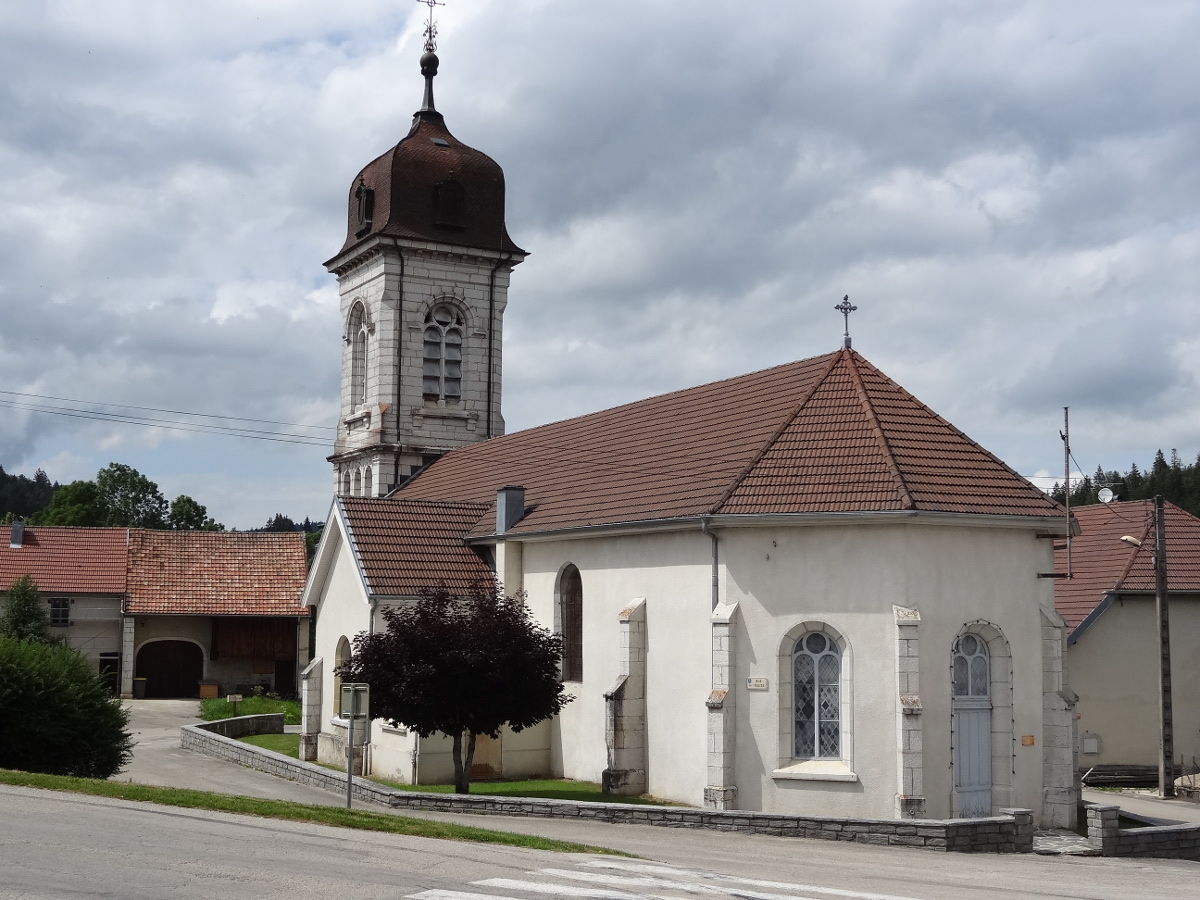
The Christian presence in Vaux is very ancient: the « Chronicle of Romainmôtier » mentions a « colony of monks » who arrived as early as the 9th century to found « the priories of Vaux and Saint-Point, and the hermitage known as Mont du Four. » The existence of the village of Vaux is attested by a charter of 1126, but it was only in 1507 that the inhabitants were authorized to build a chapel in the village, the chancel of which, now part of the church, may be a remnant. The church of Vaux is dedicated to the Nativity of Our Lady. It is a relatively simple building (a Latin cross plan, a single nave preceded by a bell tower and opening onto a chancel with a flat apse) and a composite in terms of its construction periods: the bell tower (covered by an imperial roof) was built in the 19th century, the nave in the first quarter of the 16th century, and the 18th-century chancel was modified in the 19th century. Stained-glass windows illuminate the chancel, the axial chapels of the transept, and the nave.
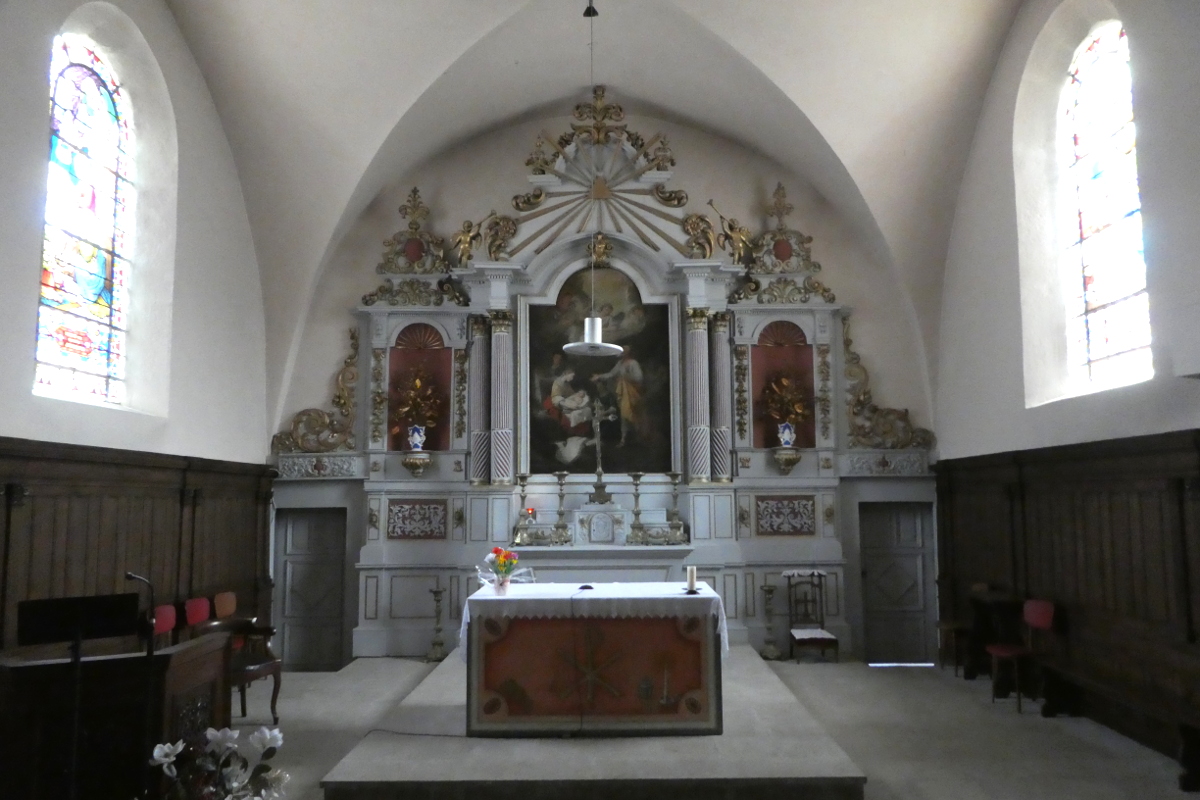
The altarpiece, created by Augustin Fauconnet, is in keeping with the tradition of Baroque altarpieces in the Haut-Doubs region: Baroque in its movement, its three-tiered rhythm with a canopy, columns, capitals, volutes, and niches, its colors (a gray background enhanced with gold and red), and its almost theatrical aspect; but it also remains very typical of the Haut-Doubs in its restraint, poised between wisdom and austerity. The central panel of this altarpiece is particularly interesting, as it depicts the Nativity of the Virgin Mary, painted by the Swiss artist Jean Wyrsch in 1771.
The church also houses a large wooden sculpture of Christ in Chains. This sculpture is generally dated to the second half of the 16th century and is associated with Flemish and Burgundian models, although its exact provenance has not been definitively established. It is said to have once been housed in an oratory located between Vaux and Chantegrue. However, its quality and size suggest a different origin, perhaps the Abbey of Mont-Sainte-Marie.
A polychrome and gilded wooden statuette of the Virgin and Child, uncertainly dated to between the 13th and 16th centuries, is also on display.
GPS : 46,739577 / 6,230343